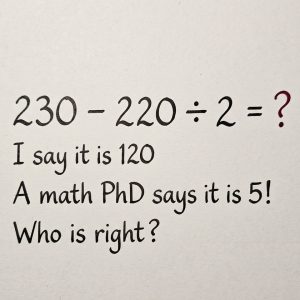
Think you’re good at mental math? Here’s a simple-looking challenge that has sparked plenty of debate online: 6 + 4 ÷ 2 × 5 = ? Some people answer 25, others say 16, while a few come up with 10. The trick isn’t difficult arithmetic; it’s knowing the correct order of operations. Can you get it right without reaching for a calculator?
The most common mistake is working strictly from left to right, starting with the addition. That gives 6 + 4 = 10, then 10 ÷ 2 = 5, and finally 5 × 5 = 25. But when an expression contains different operations, you cannot simply calculate everything in the order you see it. The standard rule, often remembered as PEMDAS or BODMAS, tells us which operations to handle first.
Here’s the important detail: multiplication and division have equal priority, so you solve them from left to right. Addition and subtraction also share equal priority, but they come afterward. In this puzzle, start with 4 ÷ 2, which equals 2. The expression then becomes 6 + 2 × 5. Next, multiply 2 × 5 to get 10, and finally add 6. That gives you 16.
So, the correct answer is 16, not 25 or 10! The interesting part is that multiplication doesn’t always come before division, despite what some people remember from school. They are equal in priority, just like addition and subtraction. Now that you know the trick, try giving this puzzle to a friend and see whether they can solve it without a calculator! 😄