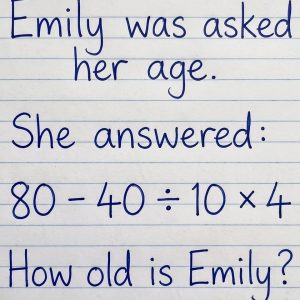
At first glance, 4 + 4 × 4 − 4 looks incredibly easy. With only small numbers and basic operations, many people quickly choose an answer. But this simple expression is designed to test whether you remember the order of operations, not how quickly you can calculate.
The common mistake is solving strictly from left to right: 4 + 4 = 8, then 8 × 4 = 32, and finally 32 − 4 = 28. That approach would be correct if the expression contained parentheses around the addition, but it doesn’t. Under PEMDAS or BODMAS, multiplication and division are performed before addition and subtraction.
So, start with the multiplication: 4 × 4 = 16. The equation then becomes 4 + 16 − 4. Since only addition and subtraction remain, work from left to right: 4 + 16 = 20, followed by 20 − 4 = 16. Therefore, the correct answer is 16.
These puzzles often fool people because the brain naturally wants to process a short expression quickly, especially when the numbers look simple. The key is to pause and identify which operations have priority before calculating. If you got 28, the arithmetic itself wasn’t necessarily the problem—the mistake was performing the operations in the wrong order. The correct answer is 16.